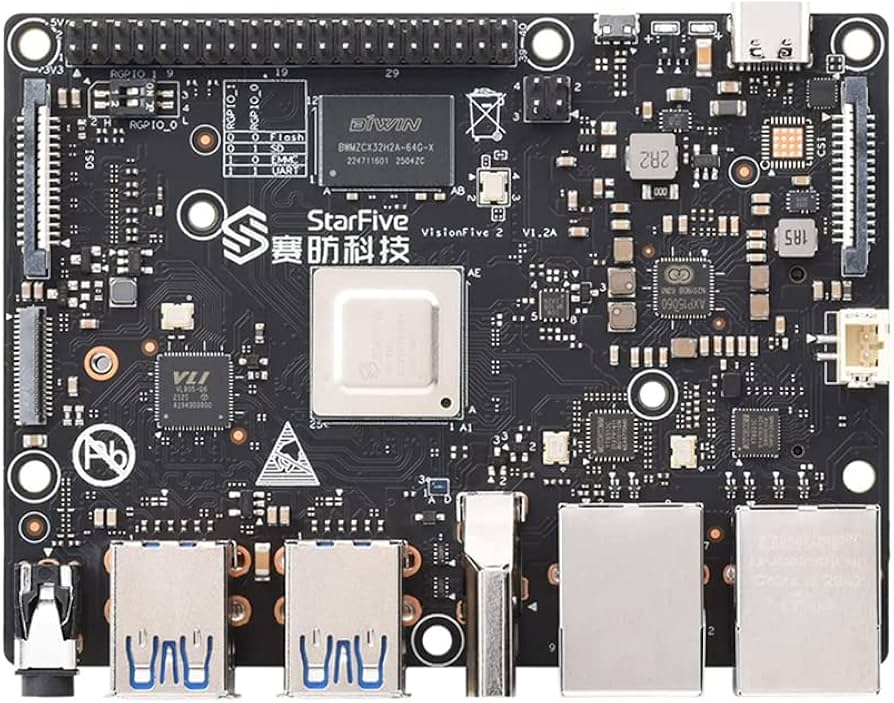
The StarFive VisionFive 2 board is built around the StarFive JH7110 SoC: four SiFive U74 cores at 1.5 GHz (rv64gc, scalar — no vector extension), integrated IMG BXE-4-32 MC1 GPU (OpenCL 3.0 / Vulkan 1.2), 8 GB RAM, typically running Ubuntu 24.04.
Video walkthrough
1.69× HPL on RISC-V: U74-Tuned OpenBLAS on VisionFive 2 (EESSI) — all videos
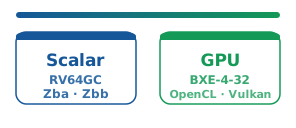
Compute paths on this board
The JH7110 has scalar CPU cores (U74-tuned OpenBLAS) and an integrated GPU — no RVV vector unit or vendor matrix extension.
HPL via EESSI
See also the HPL app overview.
End-to-end benchmark on real VisionFive 2 hardware using EESSI 2025.06-001 on the RISC-V dev stack dev.eessi.io/riscv. Problem size N=10000, block size NB=192, 2×2 process grid (4 MPI ranks).
| Before | After | Speedup | |
|---|---|---|---|
| HPL (N=10000, 4 cores, 2×2 grid) | 3.13 GFLOP/s (213 s) | 5.28 GFLOP/s (126 s) | 1.69× |
Before — stock OpenBLAS 0.3.30 (generic rv64gc kernel). After — U74-optimized OpenBLAS (easyconfigs#26436).
Stock OpenBLAS falls back to the generic RISCV64_GENERIC C 2×2 GEMM kernel (~3 GFLOP/s on HPL). A hand-tuned scalar 4×4 DGEMM micro-kernel for the U74 pipeline (OpenBLAS#5903) lifts single-core DGEMM from ~1.4 to 1.77 GFLOP/s and 4-core DGEMM to 6.31 GFLOP/s.
Reproducing the optimized run
- Set up CVMFS + EESSI on
riscv64(EESSI_VERSION_OVERRIDE=2025.06-001). - Baseline:
module load HPL/2.3-foss-2025b→OMP_NUM_THREADS=1 mpirun -np 4 xhpl. - Build tuned OpenBLAS from the easyconfig PR:
eb --from-pr 26436 --robot(viaEESSI-extenduser install). - Register the new backend with FlexiBLAS and re-run the same
xhpl— no HPL rebuild.
Full walkthrough: EESSI/docs#818 — A 1.7× faster HPL on a RISC-V SiFive U74 via EESSI.